
This section offers tools, resources, and guides dedicated to strengthening and enhancing movement infrastructure. It features a guide for grassroots groups, mutual aid efforts, and bail funds, along with other resources.
November 4, 2026
2026 Arizona Proposition 317
One of the key ballot measures MJF has been monitoring is Arizona’s Proposition 317. The proposition passed with a 57.03% approval, establishing a political precedent for expanding state level terrorism classifications through ballot measures rather than through state executive orders or state legislation. The measure codifies a state level terrorism classification declaring drug cartels as terrorist organizations, and directs the Arizona Department of Homeland Security to exercise its existing authority to do everything to address threats posed by such classified groups. This development raises alarming concerns about Proposition 317 and its implications for immigrant communities, civil society, movement organizations, and legal protections.
August 31, 2026
Treasury Department Expands Counterterrorism Sanctions on Left Networks
The U.S. Treasury Department’s Office of Foreign Assets Control (OFAC) has sanctioned three organizations—Autistici Inventati, Palestine Action, and Masar Badil—along with Masar Badil leaders Zaid Abdulnasser and Rawa Alsagheer, as part of a broader 2026 U.S. Counterterrorism Strategy and Executive Order 13224. These designations impose significant legal and financial consequences, including the blocking of assets and the prohibition of U.S. transactions, while also introducing secondary sanctions risks for foreign financial institutions. In response to these developments, Muslims for Just Futures (MJF) has provided resources and primers to assist organizations in understanding compliance and navigating these sanctions risks.
New Primer
July 6, 2026
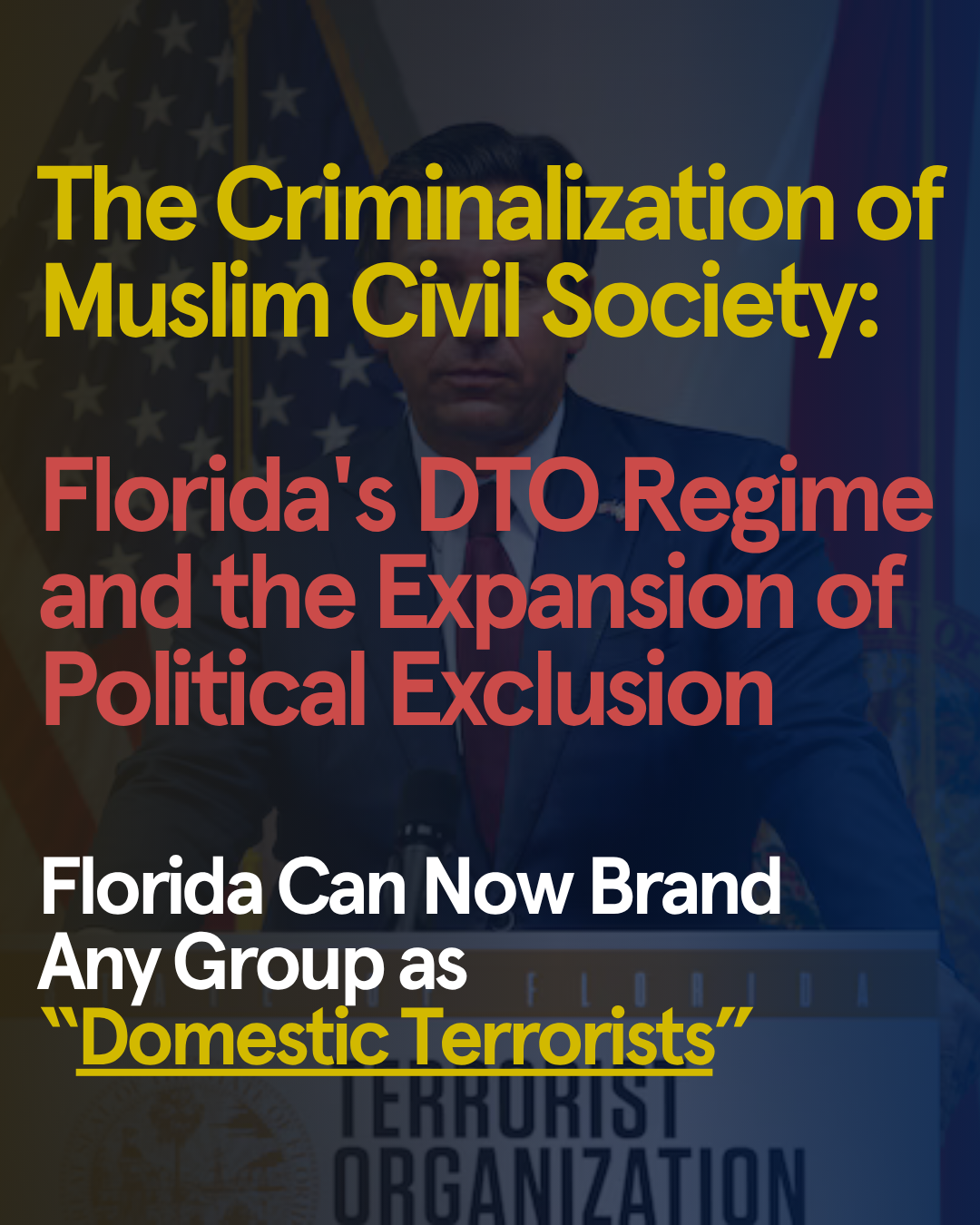
The Criminalization of Muslim Civil Society: Florida's DTO Regime and the Expansion of Political Exclusion
Florida Can Now Brand Any Group as “Domestic Terrorists”
On July 1, Florida Governor Ron DeSantis announced that he had received recommendations to designate organizations under the state's new Domestic Terrorist Organization (DTO) framework. Florida announced its intent to designate three organizations as Domestic Terrorist Organizations (DTOs)—CAIR, the Muslim Brotherhood, and Antifa—while also recognizing more than 90 federally designated Foreign Terrorist Organizations (FTOs), including several major cartels, bringing the total number of recognized organizations to more than 93 in Florida. This marks the first implementation of Florida's new designation regime and represents a significant escalation in the state's effort to expand terrorism authorities.
The primer examines what these developments mean in practice, including:
How Florida's DTO regime expands state authority to designate organizations and a far more expansive material support for terrorism apparatus.
A comparison of Florida's DTO framework with existing federal terrorism laws.
An analysis of the legal consequences for nonprofit organizations, attorneys, donors, students, and community institutions.
How the state designation regime functions as a tool of structural Islamophobia, drawing on policymakers' rhetoric and its potential to push Muslim communities out of Florida.
Why CAIR has been targeted under the new framework and the broader political context of successful Florida based movements.
An overview of the federal lawsuit challenging HB 1471 and HB 1473 on First and Fourteenth Amendment grounds.
The broader implications of Florida's approach for Muslim communities, philanthropy, and social movements nationwide.
The primer concludes with a set of recommendations for civil society, funders, and movement partners.
New Primer
June 24, 2026
Movement Memo on Financial Targeting: Executive Order 14406 and FinCEN's Updated Guidance on Information Sharing Under Section 314(b) of the USA PATRIOT Act
This memo is intended for community advocates, practitoners, and other professionals who assist individuals and communities navigating the U.S. financial system. The purpose of this memo is to provide a general overview of recent federal developments that may affect access to financial services and increased information sharing among financial institutions that may result in the expansion of financial surveillance and targeting.
In May and June 2026, the federal government announced two significant developments that will increase scrutiny within the U.S. financial and banking system. On May 19, 2026, the Trump Administration issued Executive Order 14406, "Restoring Integrity to America's Financial System," directing federal agencies to develop regulations and guidance concerning customer identification, immigration status, employment authorization, and financial activity. On June 12, 2026, the Financial Crimes Enforcement Network (FinCEN) issued updated guidance expanding the circumstances under which financial institutions may share customer information with one another under Section 314(b) of the USA PATRIOT Act.
New Primer
MARCH 2026 - Updated APRIL 7, 2026
FLORIDA 2026 - STATE LEGISLATIVE SESSION AND LITIGATION CASE - STUDY ON MST & TARGETING OF MOVEMENTS
During the 2026 Florida legislative session, multiple bills were introduced that expanded the use of terrorism language and provisions to criminalize student organizing, expand material support for terrorism statutes, and create avenues for lawfare type civil suits against individuals and organizations. These bills are part of a package colloquially referred to as Florida’s State Police Bills. The individual bills are: CS/HB 1471, CS/HB 1473, CS/SB 1632, and CS/SB 1634. On April 6, 2026, Governor DeSantis signed HB 1471 and HB1473 into law, and they will take effect on July 1, 2026.
Read this new primer on the authoritarian bills and critical lawsuit wins, including next steps and the detrimental impact of these bills on statewide movements.
New Primer
February 2026
Primer on OFAC Sanctions
This primer provides an in-depth overview of OFAC (Office of Foreign Assets Control) sanctions for movement groups, philanthropy, and broader civil society organizations. The primer covers who must comply, types of sanctions programs, activities that create sanctions risk, and the consequences of violations, including impacts on financial institutions. It also includes an annex with a glossary, a compliance checklist for groups, a resource list for organizations, and what your rights and pathways are for redress in cases of blocked/rejected transactions, suspicious activity and transaction reports, and account closures.
Derisking, Deplatforming and Debanking: Primer on Movement Financial Infrastructure
This primer helps movement organizations strengthen their financial infrastructure by offering a framework and definition for movement financial infrastructure and why it matters. It provides practical guidance for movement groups through a checklist for groups on engaging with banks and platforms, encourages the development of movement-aligned alternatives and coordinating collective responses through shared strategies. Ultimately, it encourages groups to invest in fortifying their financial infrastructure as an integral component of defending movement infrastructure.

Community Guide for Groups:
The Criminalization of Solidarity: A Practical Guide for Movements and Communities Navigating Material Support for Terrorism (MST) Laws
English and Spanish version available on webpage below.
As governments expand counterterrorism laws to suppress activism and dismantle civil society organizations, this first-of-its-kind guide from Muslims for Just Futures provides essential knowledge for movements facing heightened criminalization. This guide on the criminalization of material solidarity builds upon Muslims for Just Futures’ Guide for Grassroots Groups: Fiscal Sponsorship, Bail Funds, and Mutual Aid Basics, with a focused analysis of material support for terrorism laws. MST laws have been used against humanitarian organizations providing medical aid and food, organizers and advocates pushing for accountability for government repression, and criminal defense attorneys. This document provides a strategic analysis of material support for terrorism (“MST”) laws and their impact on movement organizations and communities.
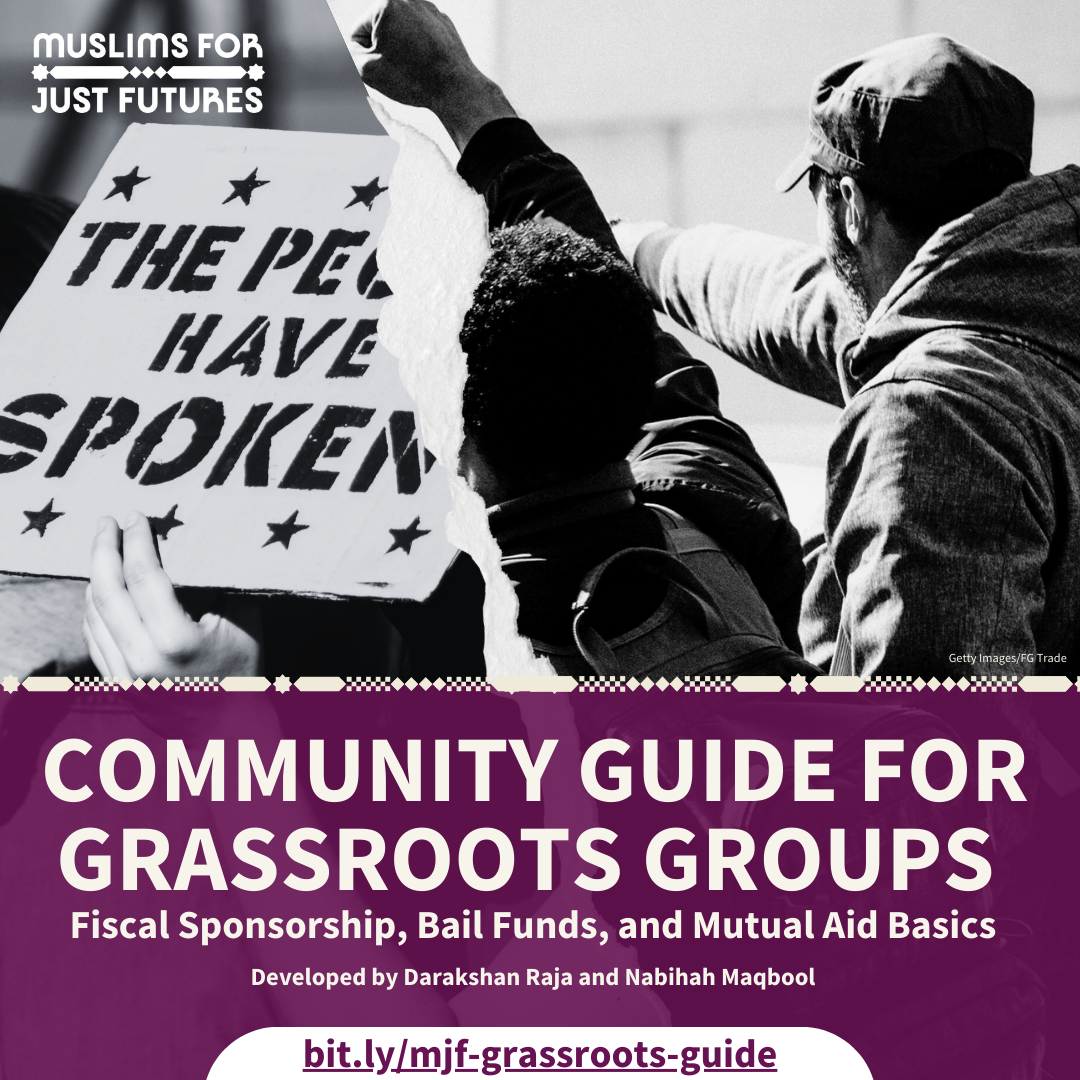
Community Guide for Grassroots Groups:
Fiscal Sponsorship, Bail Funds, and Mutual Aid Basics.
This guide provides practical frameworks for managing legal structures, compliance, and record-keeping, alongside threat-mapping tools to build resilience against risks such as government scrutiny. It also includes Know Your Rights (KYR) resources tailored for mutual aid efforts, featuring insights from seasoned organizers and legal experts. Please note, this guide is informational and not a substitute for consulting an attorney.