
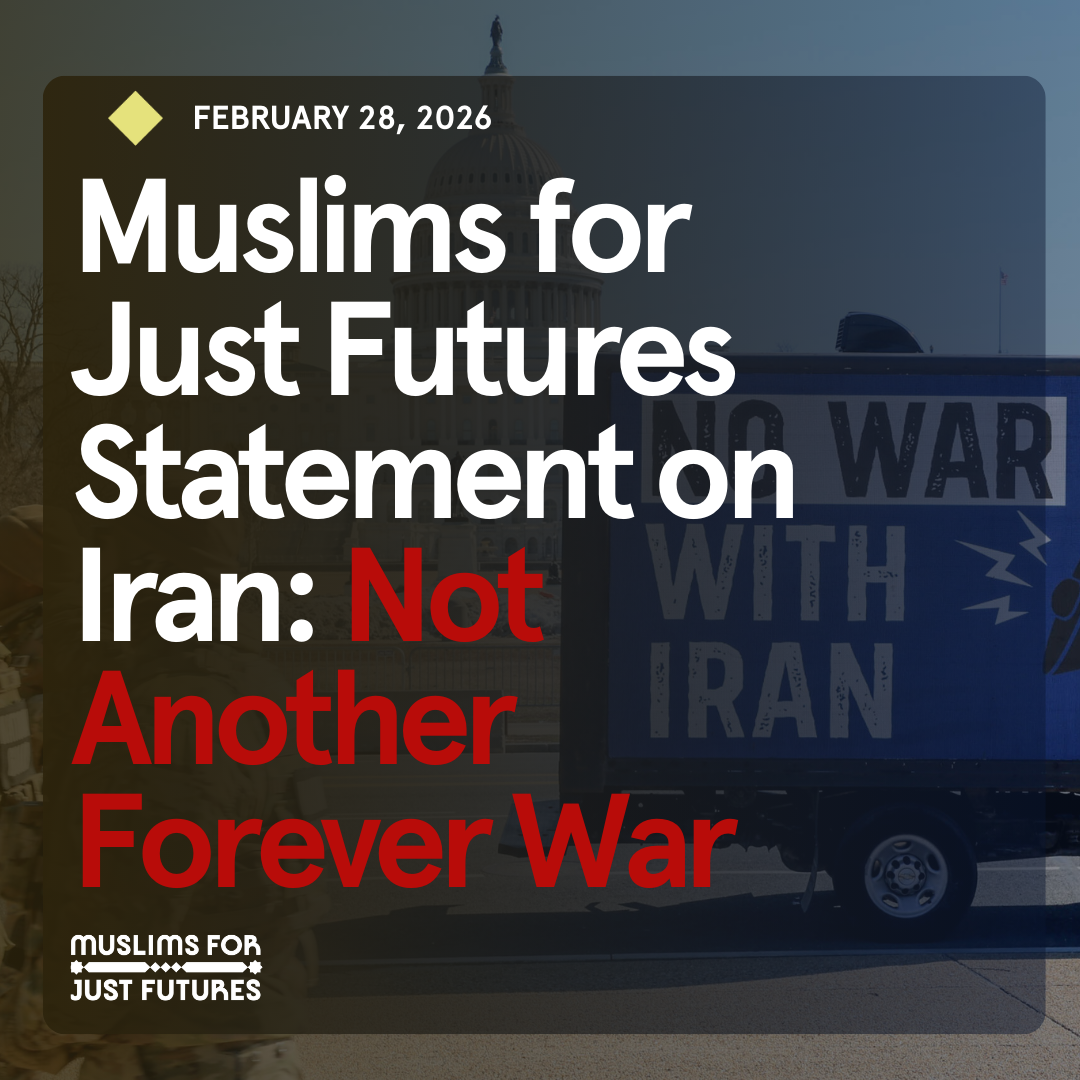
Statement on Iran
Not Another Forever War
Muslims for Just Futures (MJF) is deeply concerned about the impact of the joint U.S.- Israeli military strikes against Iran given it risks plunging the broader Gulf, Middle East, and Arab region into a deeper, more protracted conflict. This action raises profound moral and practical concerns about the targeting of Iranian people and all civilians across the region. The Red Crescent has reported that at least 201 people have been killed across 24 provinces, including children at a girls school. The Iranian state has retaliated by targeting strikes against Israel and US assets in Qatar, the UAE, Kuwait, Bahrain, Jordan, Saudi Arabia and Iraq.
In addition to moral concerns raised for over 25 years about ending forever wars and the dangers of military escalation, we offer four critical rebuttals to the narratives being shared by the administration to justify these actions.
We call for an immediate end to escalation and war.
We have included urgent next steps, but we underscore that the board is being reset. The issues we are navigating require a dual strategy, short-term and long-term, that cannot be established without a strong movement and community infrastructure to address the harms caused by state terror.
All communities deserve to live in futures free of state terror. All communities deserve to live with autonomy and freedom.
I. Ending the Longer Arc of U.S.-Led State Terror from Wars, Interventions, and Regime Change
President Trump’s decision to bomb Iran builds upon an existing playbook that has been deployed for over 70 years. From the Cold War to the 25-year War on Terror, this playbook has consistently relied on interventions, proxy conflicts, sanctions regimes, and the steady rise of authoritarian state power across multiple governments.
Over just a 20 year period, the devastating results include more than a million deaths in post-9/11 wars, approximately $8 trillion spent, and entire regions left destabilized. Past regime change efforts, like the 1953 overthrow of Iran’s democratically elected government did not produce freedom, stability, or peace.
The people living across SWANA/MENASA regions deserve better than having to engage in calculations where they are forced to choose between foreign interventions, destabilization, South-South state violence, dictatorships and corrupt leaders.
All communities deserve to live with futures free of state terror. All communities deserve to live with autonomy. Deploying this failed strategy again, particularly amidst the ongoing genocide of Palestinians and the broader War on Terror, is morally and strategically bankrupt. The only viable path forward is an immediate end to war, a commitment to diplomatic engagement, and a path that centers justice and accountability.
II. Debunking the “high risk, high reward” argument by the Trump Administration
The Trump administration is justifying war by deploying a high risk, high reward narrative aimed at investors and corporate actors. It is crucial to uplift that instability risks global markets and critical supply chains. As CSIS analysis on potential oil disruption scenarios makes clear, war with Iran would directly endanger the global oil supply chain, particularly through the Strait of Hormuz, a critical chokepoint through which roughly one-fifth of the world’s oil transits.
Risk to this corridor could impact global markets by triggering price spikes, higher shipping and insurance costs, and temporary withdrawal of tankers, tightening supply and pushing crude prices sharply higher. Because oil is embedded across global transportation, manufacturing, and logistics networks, such shocks would reverberate through supply chains, raising input costs and inflationary pressures worldwide.
From investors, corporate actors, to everyday people, rising fuel prices would add to increasing uncertainty around the economy. Increasing fuel prices create a cascading effect, impacting cost increases across numerous sectors that are felt from global markets to your individual family’s budget.
The economic risk here to the majority, from markets to Americans, is indefensible.
III. Resist Authoritarianism at Home
Wars inevitably expand executive power, often gutting democratic checks and balances under the guise of National Security. This framework has been deployed throughout American history to justify harm against communities. For a President to wage strikes abroad while circumventing procedures that require Congressional approval is deeply dangerous.
In an environment, where the President has deployed the military against American citizens and civilians, disregarding states’ rights, ensuring checks and balances exist is critical to defending democracy. Unchecked war-making authority deepens authoritarianism and democratic governance. At a point in time where the global and local are deeply interconnected, we cannot afford to look away and not see the connections between impunity at home and impunity abroad.
IV. Fractured Solidarity & New South-South Conflicts
This escalation is unfolding during the holy month of Ramadan, a sacred time centered on reflection, mercy, and community for over a billion people worldwide. Initiating a significant military confrontation during this period sends a clear message of disregard and dehumanization toward Muslim communities that the U.S. military is a force of White Christian nationalism.
Additionally, the trajectory of this conflict will further erode remaining solidarity among Muslim-majority states, placing them in conditions of heightened tension, proxy warfare, and political confrontation with one another. Such dynamics will risk fueling new South–South conflicts and deepen regional instability for decades to come. In doing so, they will contribute to the reemergence of a renewed “War on Terror” paradigm, one in which prolonged instability creates openings for external powers, including the United States and Israel, to exert influence in ways that will further destabilize regions and entrench cycles of conflict for decades into the future.
Given the gravity of this moment, its critical to offer these narrative points and ensure government representatives and decision-makers are clear that Americans say no to war.
Take action through this petition and let your Representatives know that you are against war.